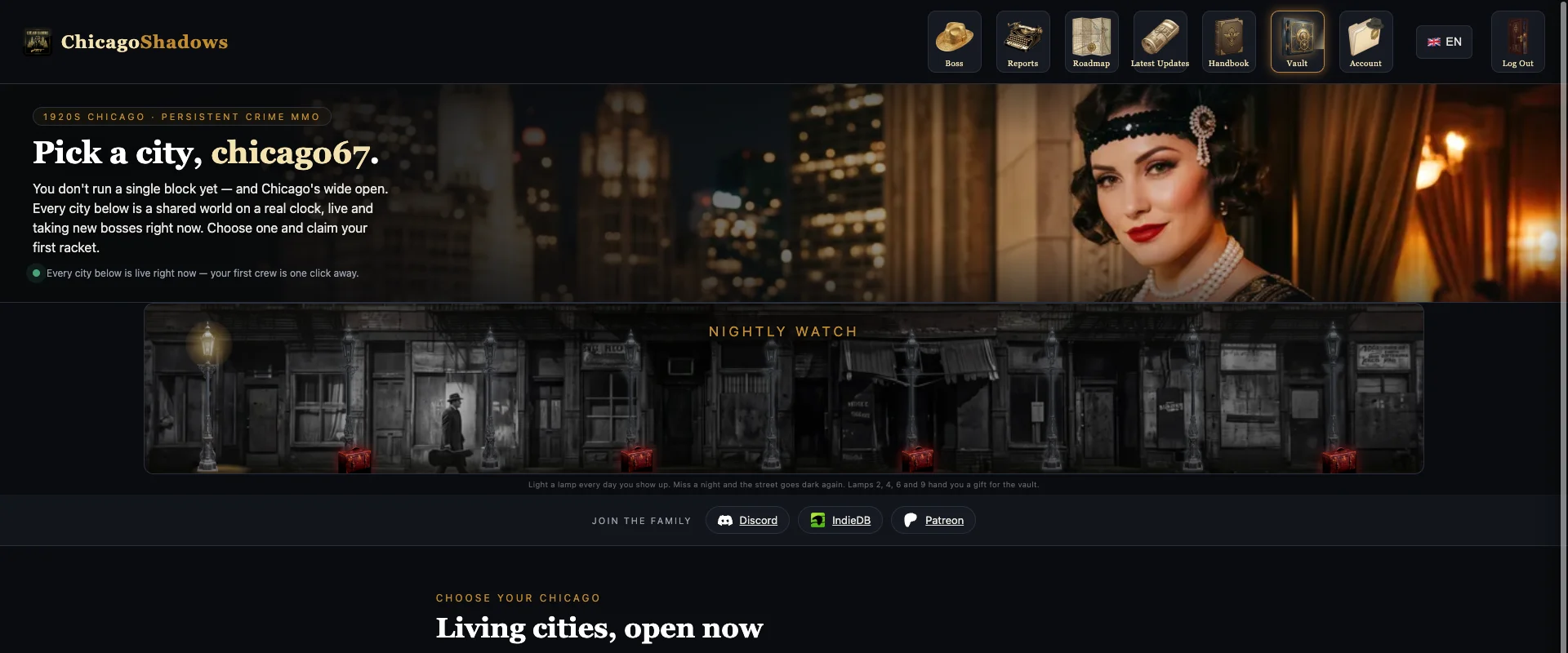
The first thing the game tells you is that you are late. A lamp-lit alley, a short list of cities, and a line that reads less like a welcome than a warning: pick a city, the streets are already busy, choose one and claim your turf before someone else does. The cities on that list are not waiting rooms. They have been running for days — rackets paying out, crews on the move, the Herald going to print — long before you typed your name. You do not start a game here. You walk into one already in progress.
A clock instead of a button
For most of its history, ChicagoShadows ran on rounds, like nearly every strategy game of its lineage. You wrote your orders, you pressed a button, and the week resolved in one synchronized thunderclap once everyone else had pressed theirs too. The city held its breath between turns. Now there is no breath to hold. No rounds, no weekly tick, no ready button — the old Start Week control is gone from the screen, because there is no week to start. Every order resolves on its own timer, the moment the crew actually arrives, and the world runs day and night whether you are logged in, asleep, or at work pretending not to be.
The clock underneath is specific. An in-game day is twelve two-hour slots, and the city's economy is wired to them. Businesses pay out at Supper. Payroll lands at Speakeasy, two hours later. Heat, fear and respect bleed off at the Witching Hour, when the city quietly forgets a little of what you did. How fast those days pass is a property of each world: the default is one in-game day every six real hours, and worlds can run anywhere from real time up to sixty-four times faster.
Forty-three bosses, one city
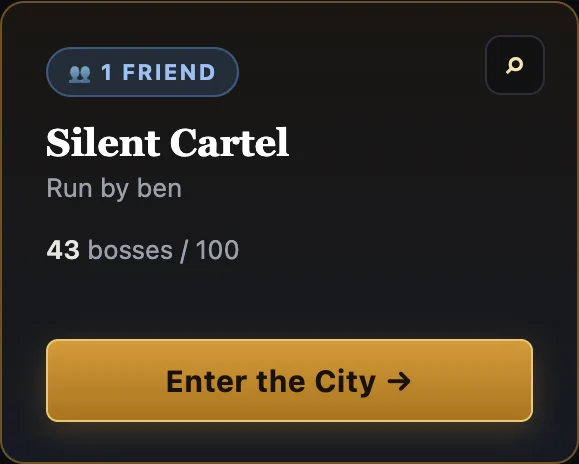
Take one world. Silent Cartel has been running for twelve straight days at sixteen times speed, months of in-game time without a single pause. Forty-three bosses share it, forty run by the engine and three human, against a cap of one hundred. On an ordinary afternoon the city was carrying roughly forty-five extortion crews and thirty robbery crews on the streets, twenty-one patrols on their rounds, eleven guard posts standing watch, and sixty-two fights in progress where crews had run into each other. None of it was set up for show. It was simply what the city was doing.
The map is the show
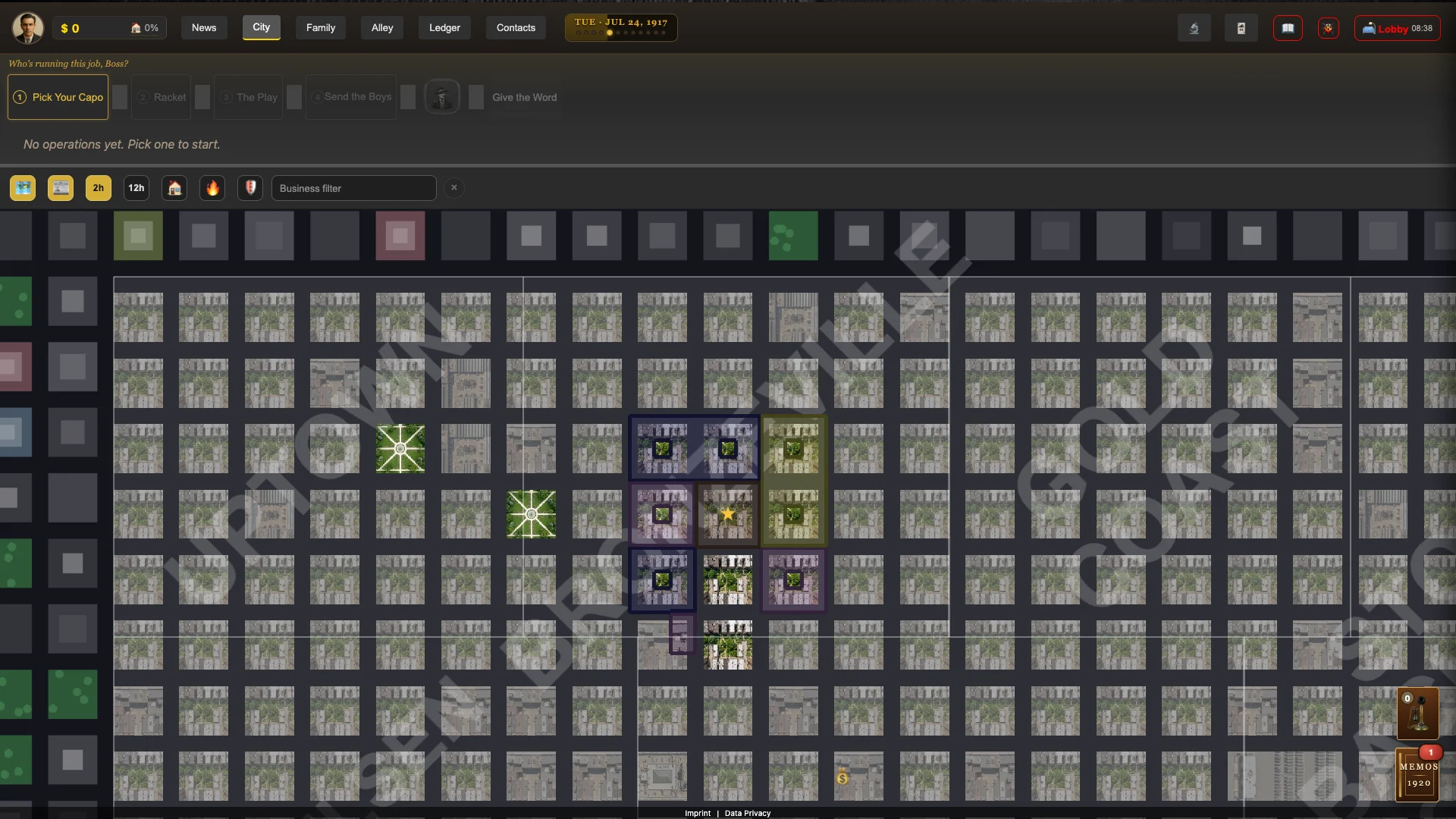
The strategic map is where all of this stops being an idea and turns into something you can watch. Every visible crew in the city rides onto the map as a small badge wearing its capo's portrait, and the badges move — along real street routes, block by block, at whatever pace the world's clock sets. Your crews, rival crews, the city's patrols. When two crews end up on the same spot with plans that do not fit together, the engine catches it and drops a crossed-tommy-guns fight badge on the block. If the two families happen to be at peace, the same collision plays out as an argument instead of a gunfight. The diplomacy ledger decides which.
Same city, four pairs of eyes
A city this size has no single true view. The streets you can see, the rivals you have heard of, the turf you have managed to hold — all of it depends on which chair you are sitting in. Here is the same Silent Cartel through four different families, on the same streets and the same clock. Four completely different games.
Le Corbeau · newcomer
Start with the newcomer. The Le Corbeau family is days old, and its map is mostly darkness: a small patch of purple turf, a single HQ star, and fog in every direction — fog with forty-two other empires somewhere inside it. Everyone starts here. The city does not introduce itself. You buy your knowledge of it one block at a time.
Samuel David · blue
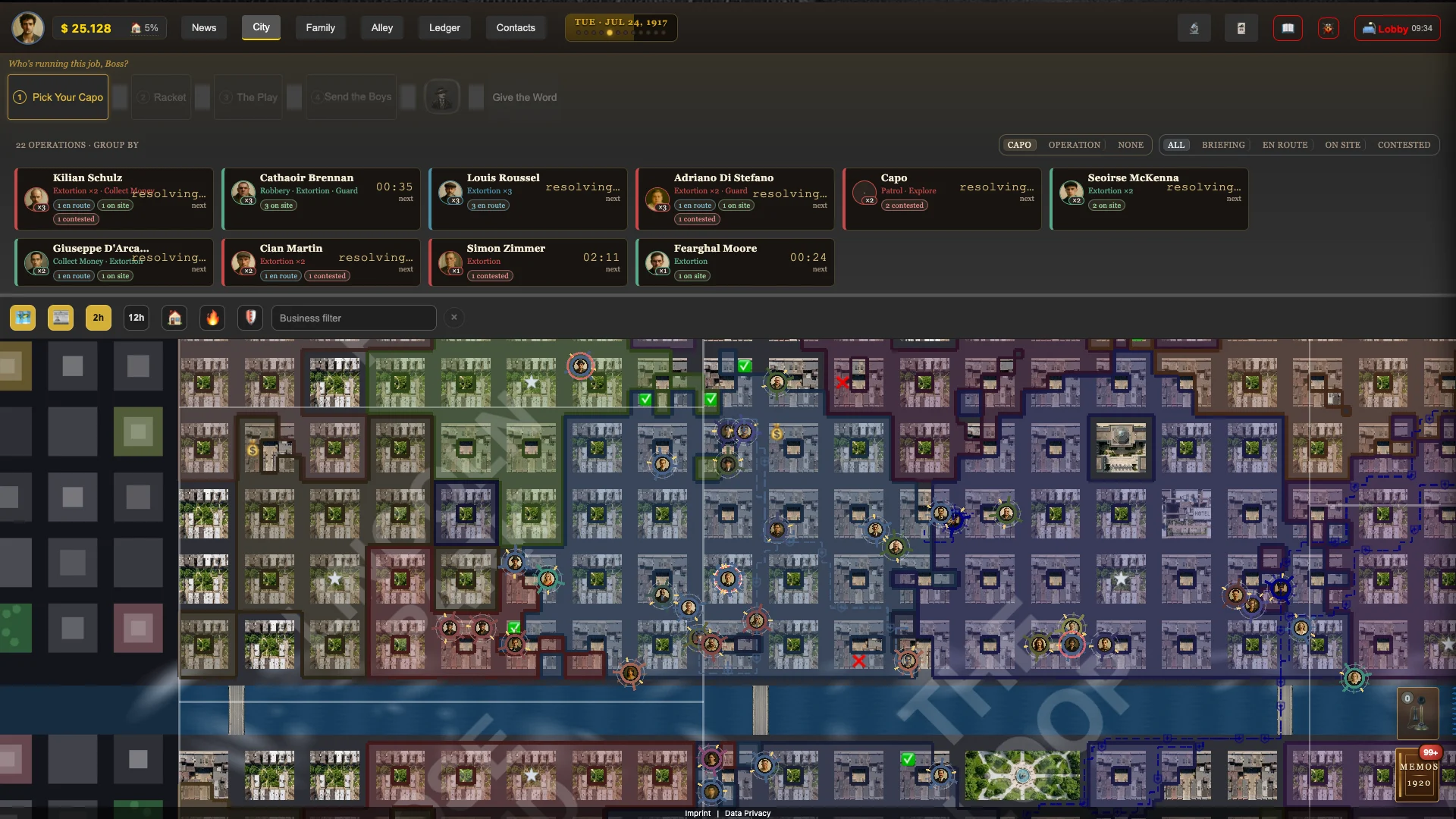
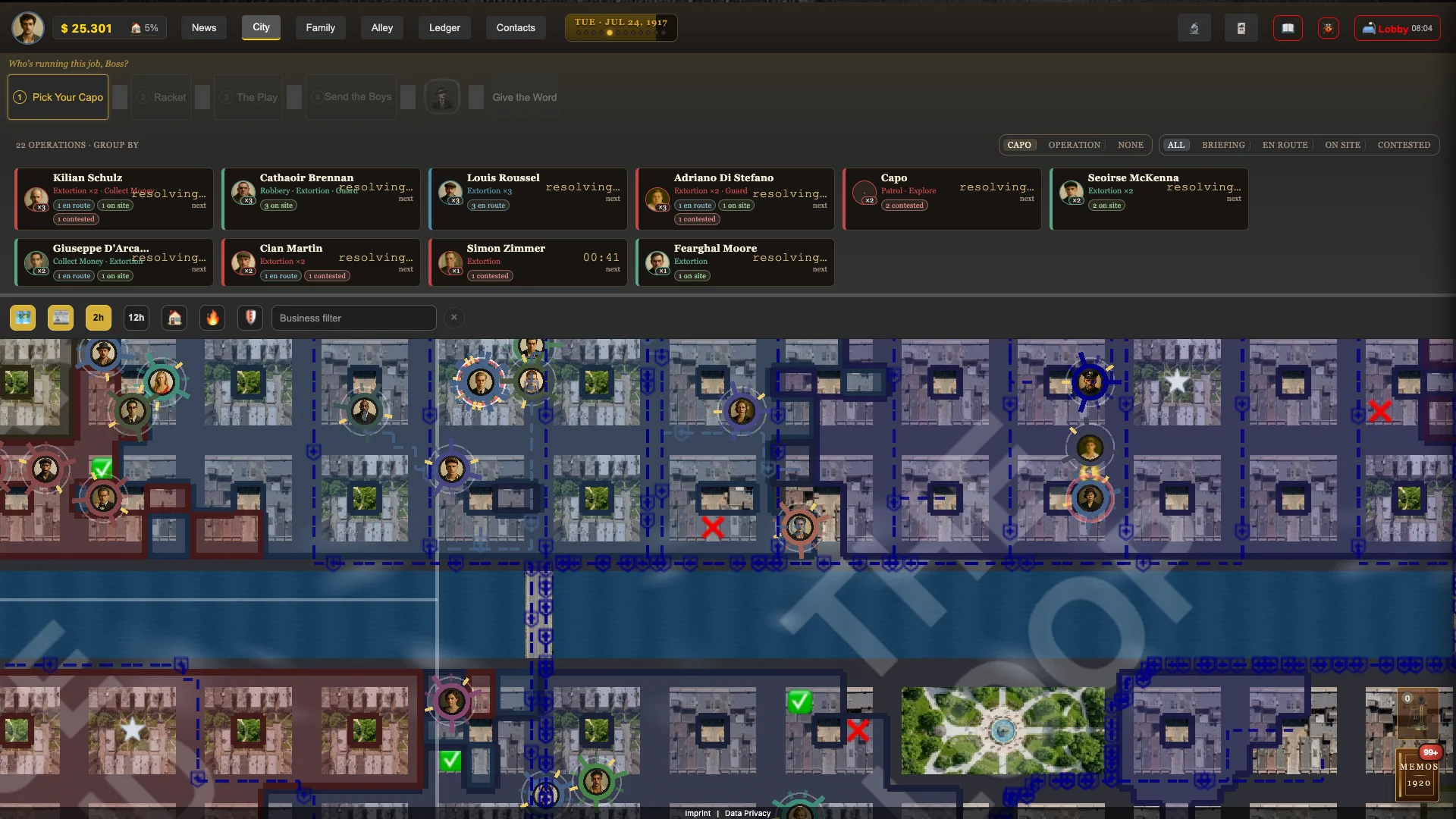
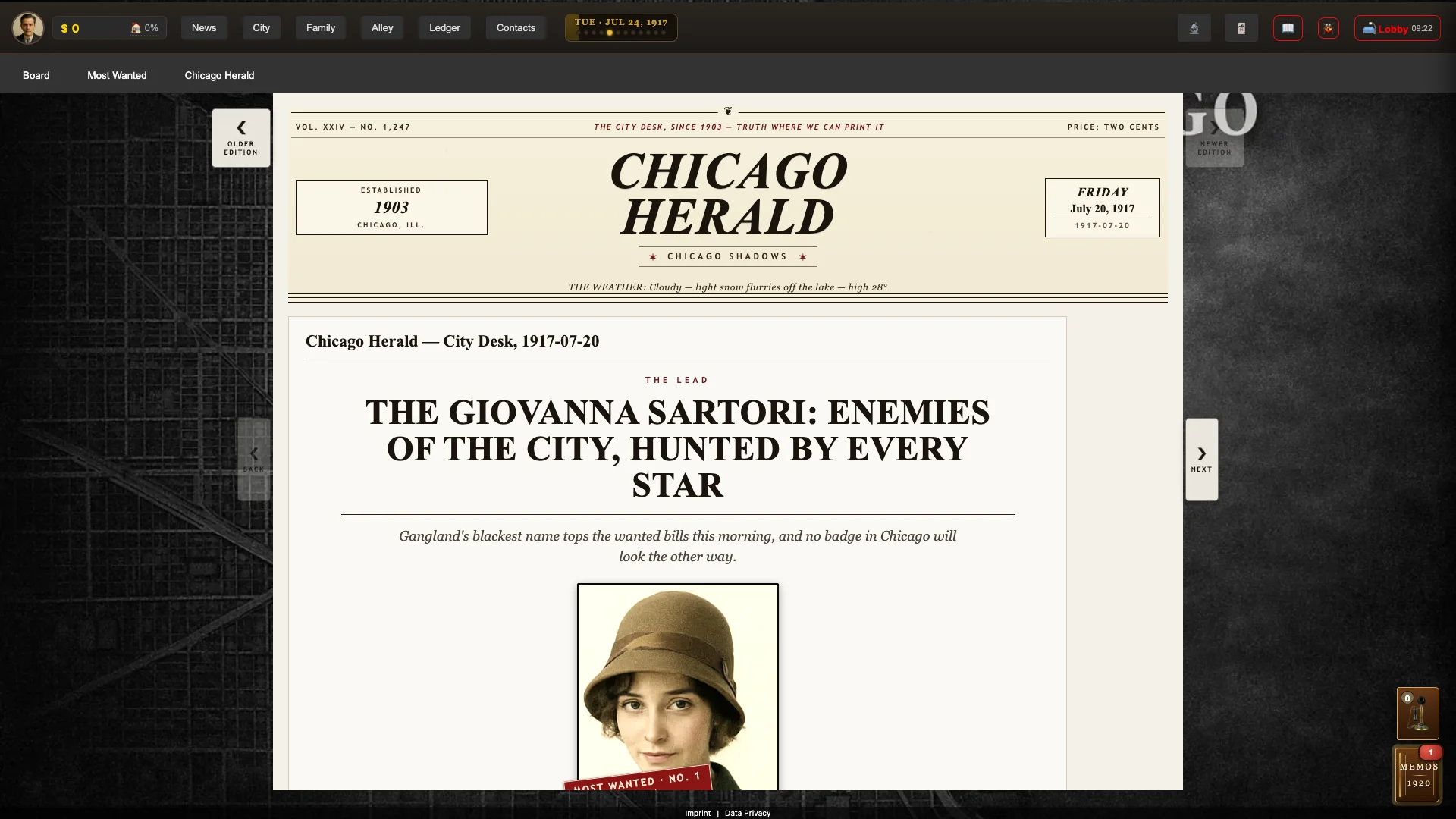
Samuel David's map is what Le Corbeau's might become. Blue territory across the districts, twenty-two crews in the field — fourteen moving, four locked in contested fights. One of those fights is worth following. The crew tangling with Samuel David's patrol answers to Giovanna Sartori, and that same week Sartori is the city's most wanted boss, her face filling the entire front page of the Chicago Herald. The paper made her a name. While the edition was still fresh, she had a crew on Samuel David's streets, picking at his patrol. The headline and the gunfight belong to the same week, and nobody arranged for them to line up.
Fearghal O'Grady · green
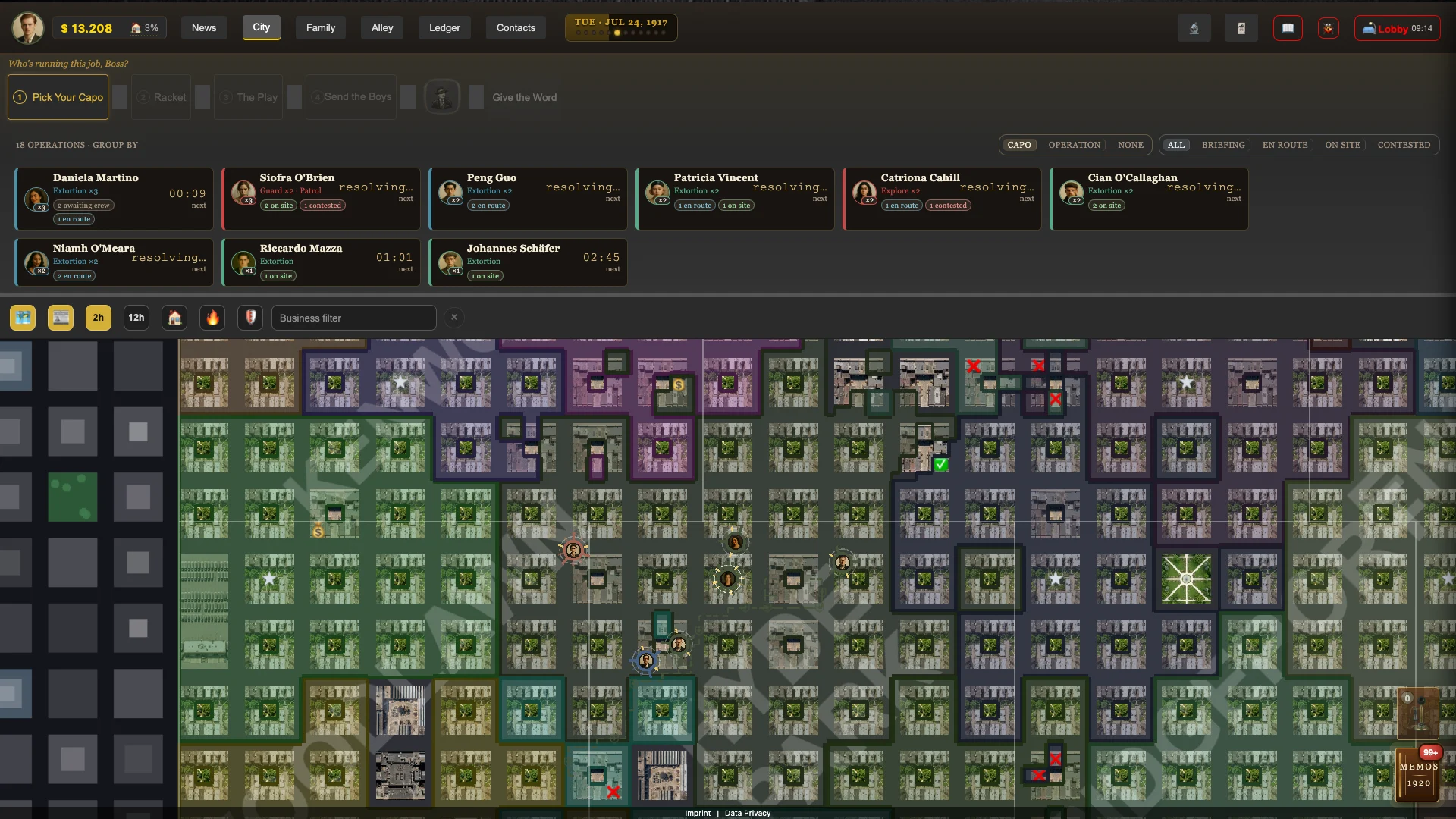
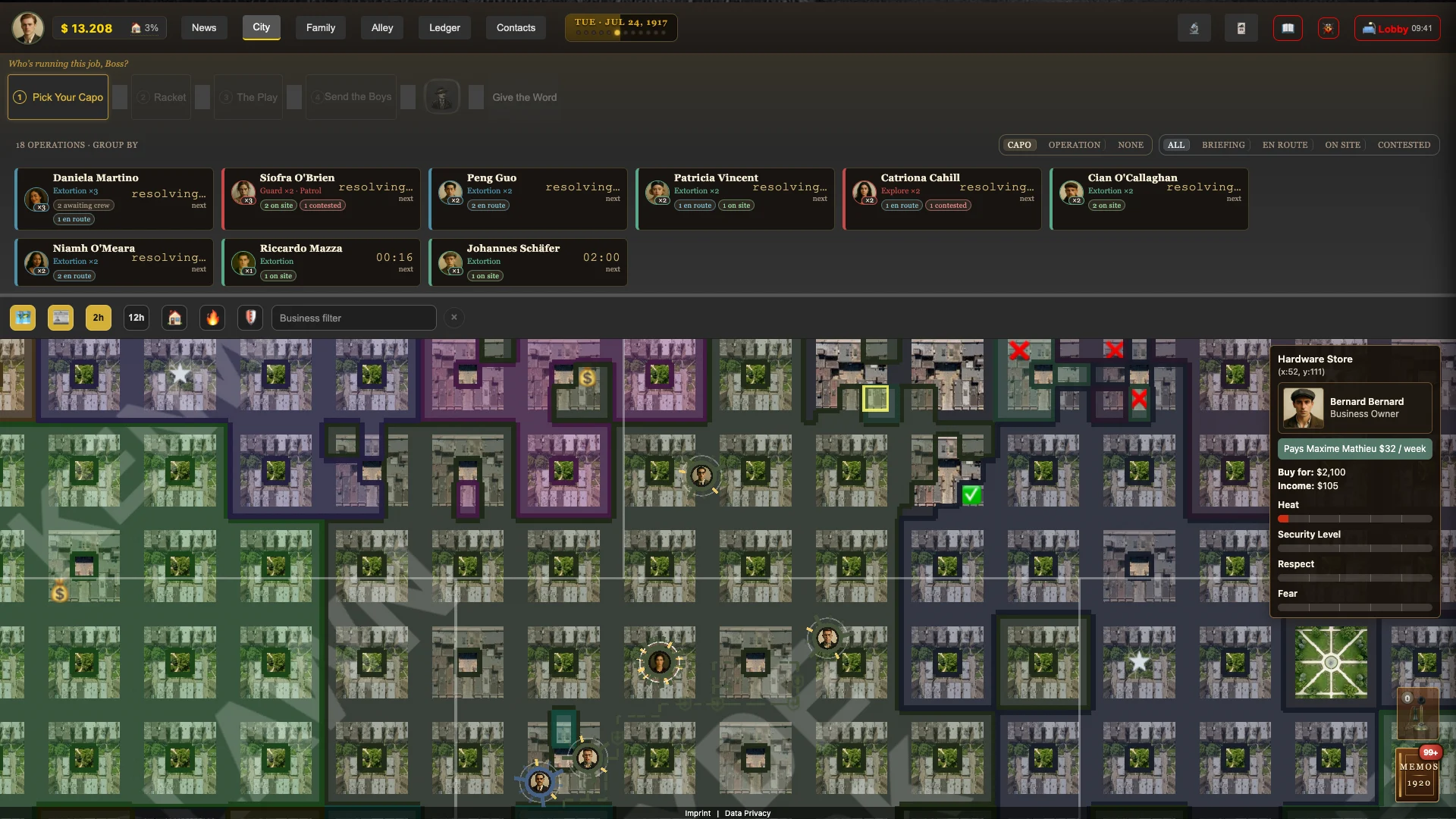
Fearghal O'Grady runs green turf with close to twenty crews out, and his roster reads like a portrait of immigrant Chicago: capos named Niamh O'Meara, Daniela Martino, Peng Guo, Johannes Schäfer, Patrizia Visconti. Hover his blocks and you find the unglamorous machinery underneath the empire — a hardware store quietly paying protection when Supper comes around.
Flavio Capone · olive
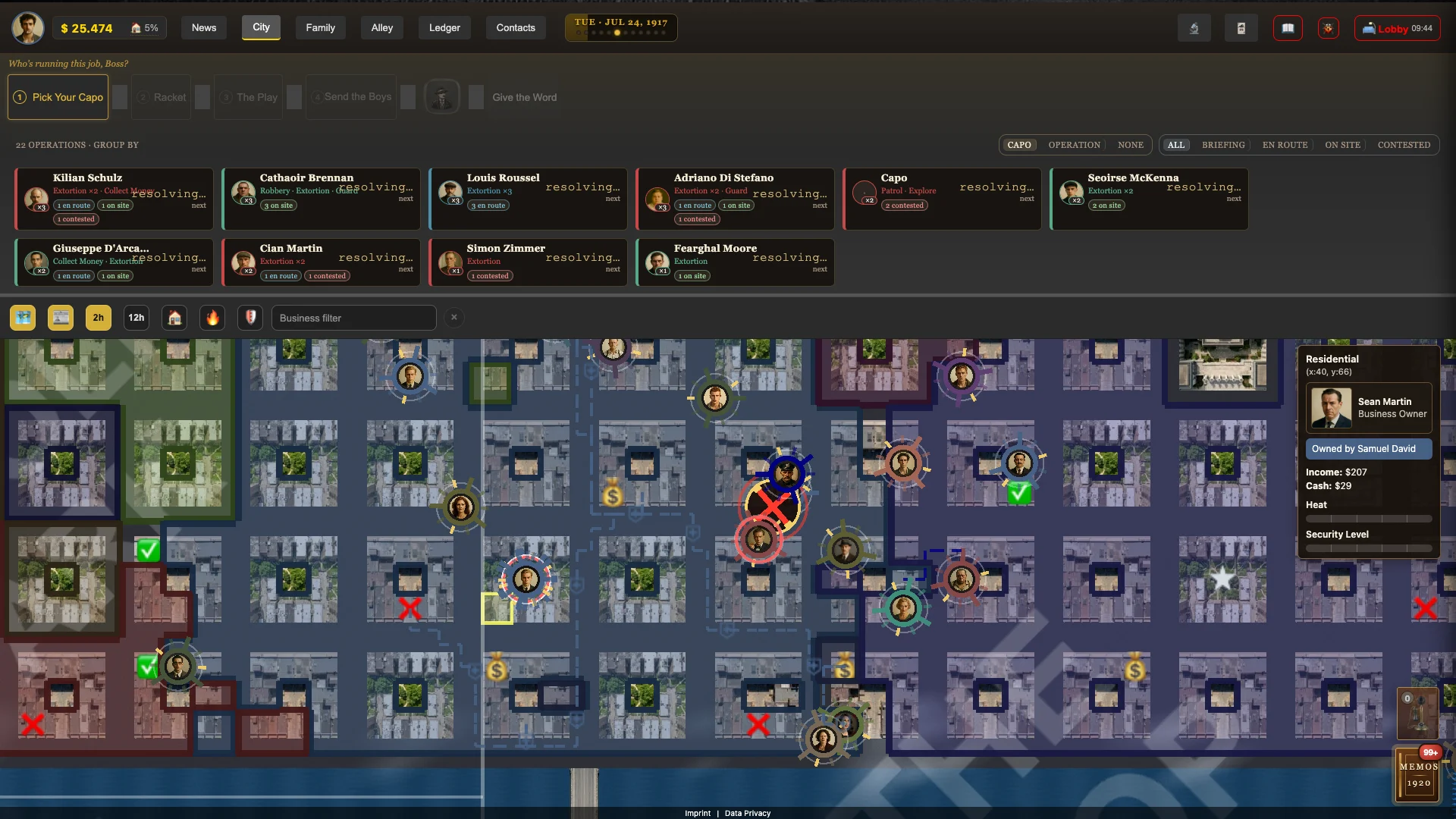
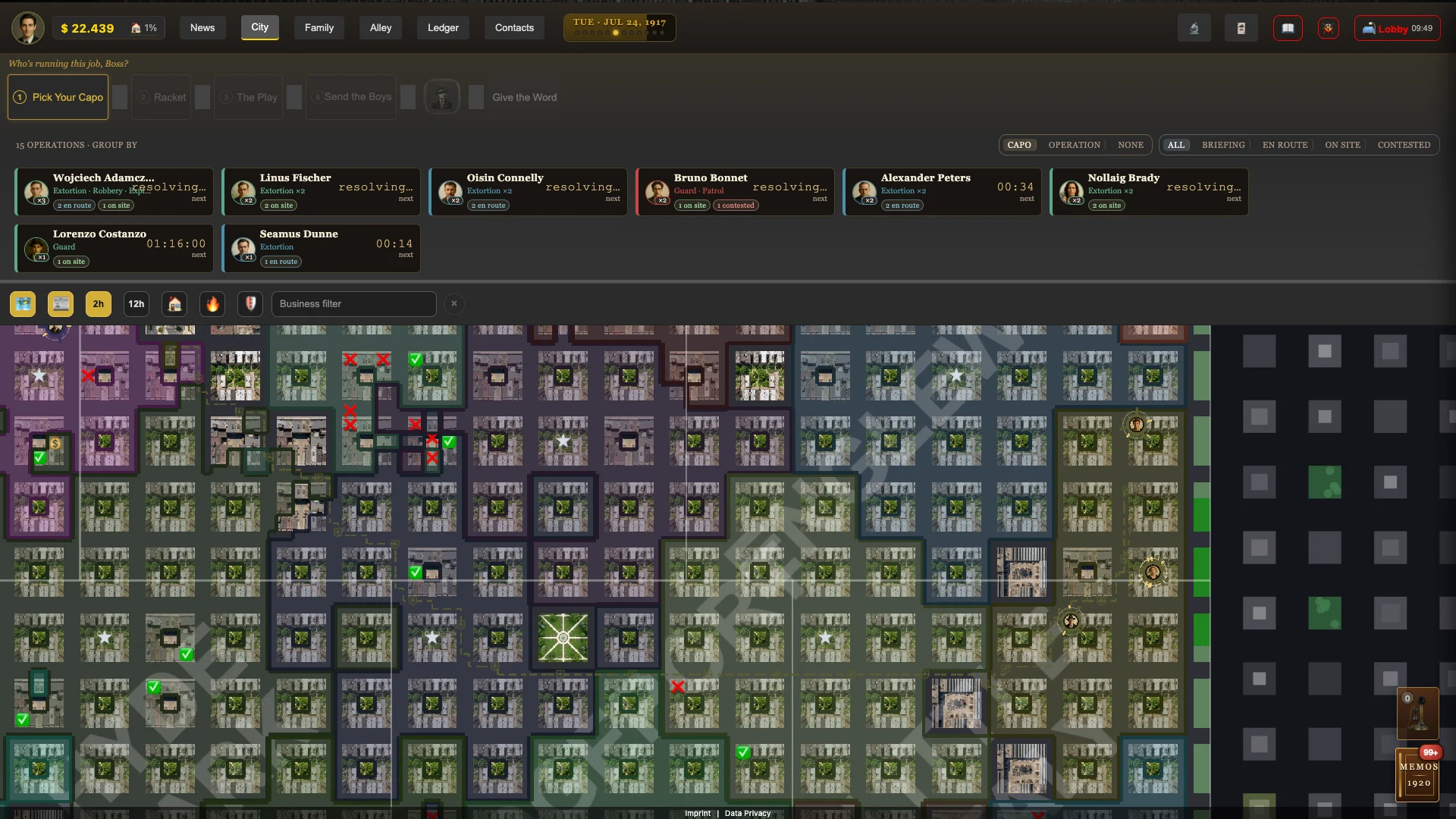
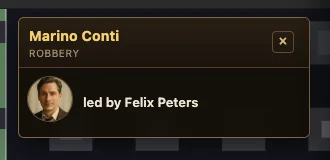
Flavio Capone holds olive ground with fog still hanging over the east of his map and more than a dozen crews out. On his streets there is a crew that is not his: a robbery crew flying the Marino Conti family's colors. Tap it and the game hands you an identity card, and the card is deliberately thin. The family's name. The capo leading the crew, Felix Peters, name and face. The work they are out doing. Nothing more. No roster, no health, no money. The map tells you who is on your streets; it will never do your spying for you. What to do about Felix Peters is Flavio's problem, and that is the point.
The city talks back
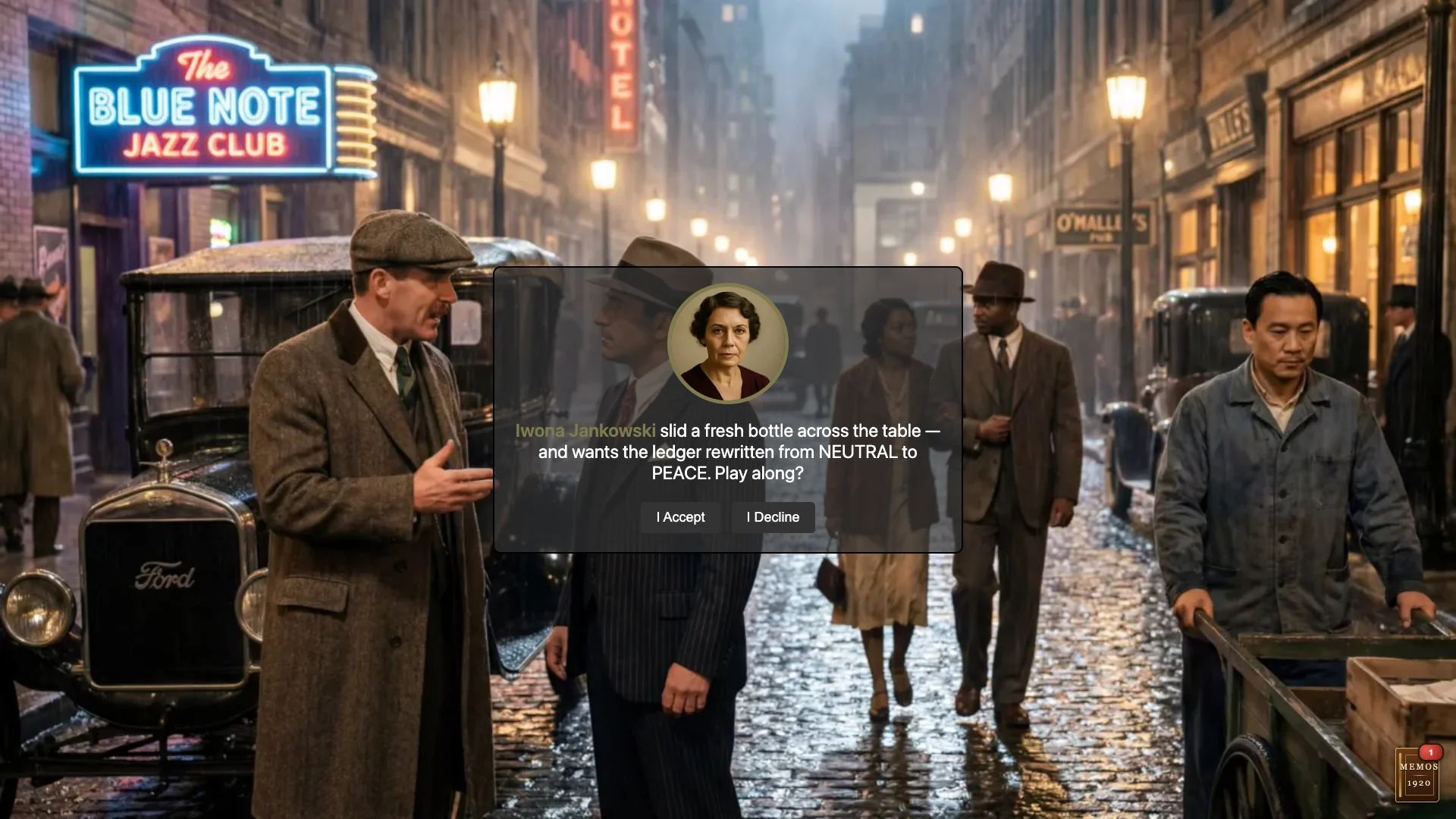
Because the world never pauses, the people in it come to you on their own schedule. A parley lands without warning. Iwona Jankowski slides a fresh bottle across the table and asks for the ledger between the two families to be rewritten from neutral to peace. Accept, and the next time your crews meet hers on contested ground they argue instead of shoot. Rival bosses send these offers live, off their own read of the city, through the same diplomacy ledger you use against them. Underneath it all runs The Wire, a noir news ticker where wars, boss deaths and folding families slide across in a single line and fade — no log, no history, just a rumor passing through. The lasting record comes separately: the Chicago Herald goes to print once an in-game week, at Daybreak, and the city reads it whether you do or not.
Why the crowd works
Rounds put a quiet ceiling on how many people can share a city, because every extra boss is one more person the whole world has to wait on. Drop the waiting and a hundred seats per city stops being a scheduling nightmare. Silent Cartel's forty-three bosses have never once held each other hostage. The one who plays at three in the morning and the one who steals fifteen minutes at lunch are in the same fight, on the same clock, and neither needs the other to press a thing. The engine-run bosses keep that density honest: they take their turns through the same order pipeline you do, the same checks, with only public information to go on, so the streets stay crowded and dangerous through the hours when the humans are asleep.
Where this is going
One question hangs over a game with no rounds: if there is no final week, what does winning mean? For now, endings are personal rather than citywide. Your run ends when your boss dies or surrenders. The world itself has no round limit and no hard finish line — Silent Cartel will be running long after you close this page. That is not where the design stops, though. The direction we are building toward is a city that can be won: when one boss becomes its single dominant power, the city counts as taken and closes its books.
That last part is the road ahead, not a feature you can use today — worth being straight about rather than letting a screenshot promise it. The bones are already on the streets of Silent Cartel: one shared city, power you can see, and a paper that already knows how to put a single boss above everyone else.
ChicagoShadows is free in any browser. The 1920s crime MMO with no rounds and no wipes. Silent Cartel is still open, the Herald is still printing, and the streets above are already old news. Go make some of your own.